
Walks · Caldera de los Cuervos · Parque Natural de Los Volcanes, Tinajo
El Cuervo, the crater where it all began
A short, almost level loop circles the first volcano of 1730, then slips quietly down into its open caldera.
By Livia Risi · 2026-09-30
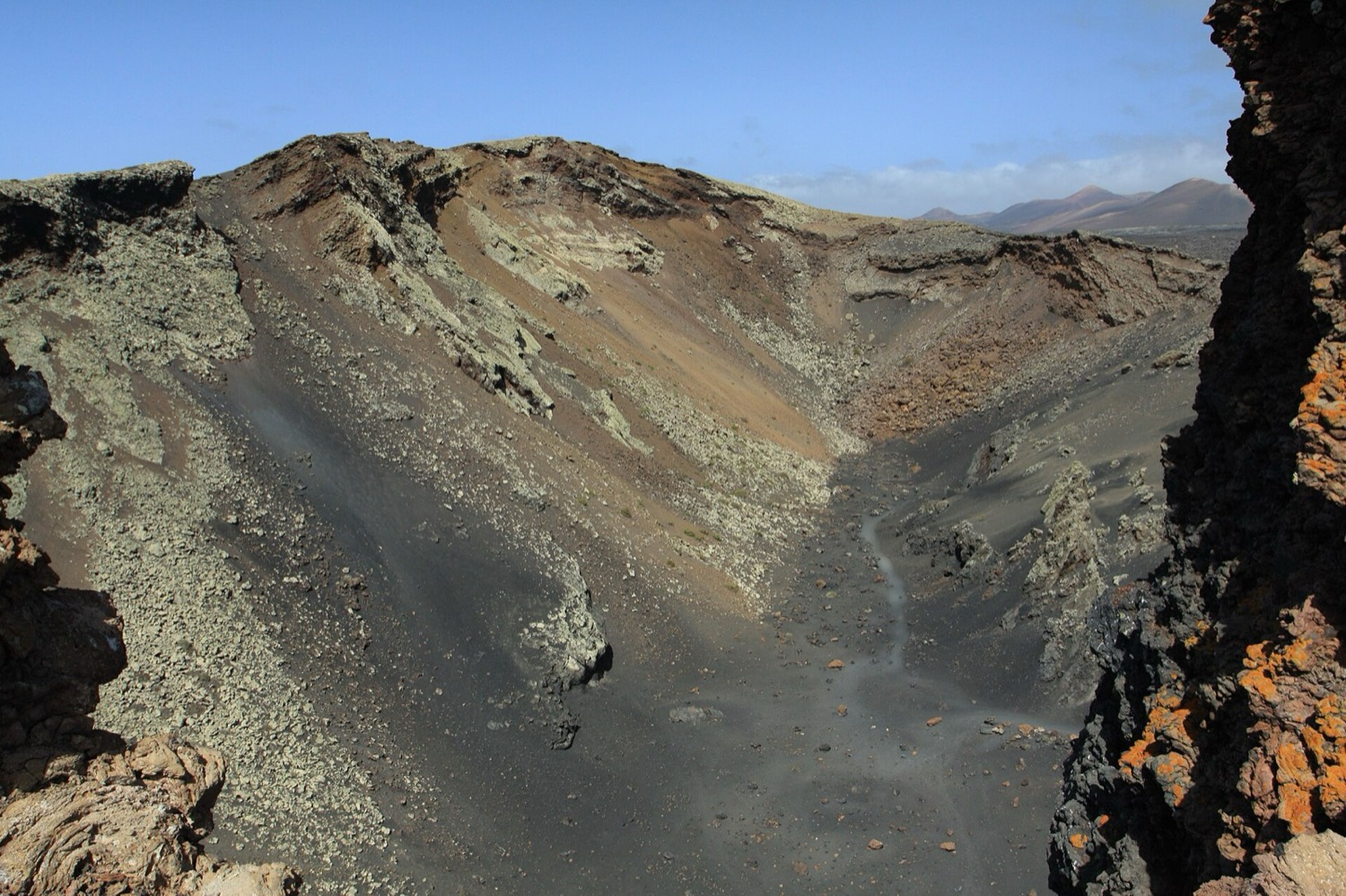
Some volcanoes are made for looking at. Others let you walk right in. El Cuervo is one of the latter. In the Los Volcanes Natural Park, in Tinajo, its jagged outline rises alone above a sea of hardened lava, and a single unhurried morning is enough to know it from the outside in.
Its name carries more weight than its size. This is where, on the morning of 1 September 1730, the ground first split open in the great Timanfaya eruption — the event that, over several years, reshaped the landscape and the lives of much of the island. The black, frozen swell that surrounds you began right here.
The trail is a gentle loop of roughly three to five kilometres depending on the variant, on firm cinder and with almost no climbing. It suits children, slow walkers and anyone who likes to stop and read: information panels along the way explain what you are standing on.
Into the caldera
The part everyone remembers comes at the end, when the path slips through a breach in the wall and drops into the crater itself. Inside, the wind simply stops. The slopes shift colour with every passing cloud — ochre, rust, charcoal, now and then a faint violet — and lichens and small green shrubs cling to the stone, life returning at its own careful pace.
Outside the rim, by contrast, the wind is constant and cool even under a bright sky. Bring a light layer, water and closed shoes: the fine lapilli finds its way into any sandal.
Getting there is simple. Take the LZ-56, the road that climbs from Yaiza and Uga through the vineyards of La Geria; there is free parking directly opposite the volcano, and the path is obvious from there. A short walk, but one that explains Lanzarote more clearly than any map.